
































 Subscribe to my YouTube
 Join My Facebook Group
 Connect on Linkedin
 Free SEO Tutorials
 SEO Case Studies
 Links That Rank


Keywords are the specific phrases or words people type into search engines and AI search tools like ChatGPT, Gemini, Claude, Grok and Perplexity when they are looking for something. It’s the starting point of every search and the foundation of SEO.
Search engines use keywords are signals to figure out what your page is about and whether it is the most relevant results to show up.
The bottom line is this:
- No keywords = no signal.
- No signal = no rankings.
If you get this right, you’ll find yourself attracting thousands of hungry visitors to your website every month through search engines.
But the problem is many people get it wrong and either attract nobody or thousands of time wasters who don’t convert into relevant traffic.
With 55% of Google searches now showing an AI Overview, it’s never been more important to get keyword research right.
So today, I am going to show you how to get keywords right!

What Will I Learn?
What Are Keywords?
Keywords are words and phrases that people type into search engines to find answers.
These keywords (or search queries) help search engines like Google find the most accurate and relevant content for your search term.
This matters even more when optimising for AI search tools like ChatGPT and Google’s AI Overviews that prioritise structured, conversational content that directly answers users questions.
That means your websites primary keyword should be focused around the problem your business solves for your potential customers.

Depending on what your business is, you might target keywords such as-
- Custom printed t-shirts
- Locksmiths in Chicago
- Online meditation courses
- Art classes Sheffield
Each of those queries explicitly state what problem your business solves.
And when people don’t know your business exists, this is how they will find you.
So it’s important that first you decide what those primary keyword are for your business, and secondly that you have optimised your on-page SEO for those keywords.
This will help ensure your site is not only relevant to what people search for, but it is also focused on attracting the right kinds of people.

How Do Keywords Work?
Keywords serve as the bridge between search engines and your website.
They take people who have search queries and pair them up with websites that answer the query.
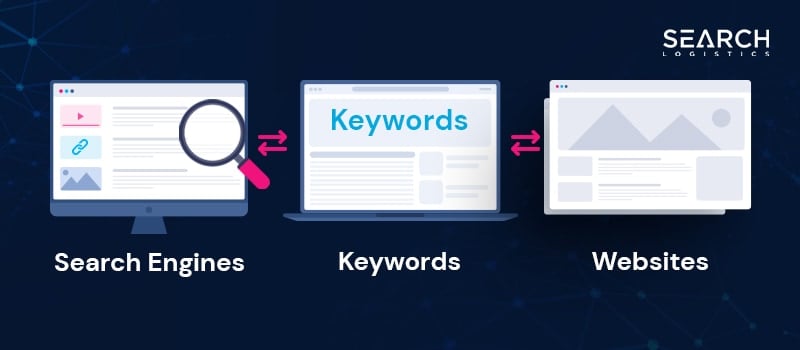
More specifically:
Keywords help search engines like Google identify what your site or content is about to help them pair the right people with the right page.
Search engines don’t automatically know the topic of your website.
Instead they “read” your content using crawlers and analyse the content to figure out which keywords are relevant to a page.
Let’s say you run a business that prints custom t-shirts.
Mentioning the keyword “custom t-shirt” on your page helps give context to your site.
Take a look at how this website has scattered the target keywords through it’s pages-


Search engines will file this away in its “custom t-shirt” department.
Then, when someone comes along and searches “custom t-shirt”…
…The website will be eligible to appear in the search results-

The end result of this is-
- The person searching finds the right website to solve their query
- The business owner gets more qualified traffic and a new customer they wouldn’t have otherwise had
To put it simply:
Keywords are the bridge between search engines and your website.

Why Are Keywords Important?
Without keywords, there would be no search engines or search engine marketing.
And there would be no way for people to find your business easily.

The search process ALWAYS starts with keywords!
Regardless of whether that search is typed into a search bar or spoken into a device.
So, if you are serious about increasing your websites revenue, you have to take keyword research seriously across your business.
Because without the right keywords and proper keyword research:
How are people going to find your business in today’s competitive search results?
And it’s only becoming more important with AI search.
AI tools are no longer just helping people navigate to websites, they are answering the search directly.
That’s why answer engine optimization (AEO) and generative engine optimization (GEO) are quickly becoming an essential part of SEO for any brand that wants to stay visible.

How Keywords Signal Search Intent
The best thing about keywords, is people search and literally tell you what they want through their search queries.
And it’s only getting more specific withe LLMs. The average search in a AI tool like ChatGPT is 23 words compared to 4 words on Google searches. People’s searches are now so specific they point blank tell you what they want and why they want it.
Your job as a business owner is to give it to them.
Different types of keywords signal different search intent, so you can make sure that you are fully focused on attracting the right types of people.
There are three kinds of search intent:
- Navigational: The searcher wants to go to a specific website or page
- Informational: The searcher wants to learn something new
- Transactional: The searcher wants to buy a product
These different types of search intent are clear from the specific words the person is searching for.
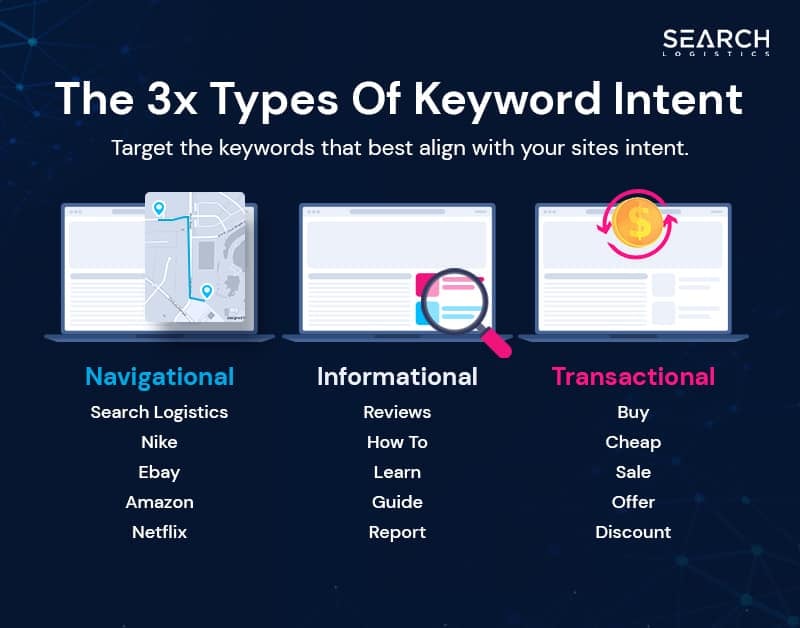
Let’s look at Nespresso coffee as a simple example:
- Navigational: If you just want to go to the Nespresso website, you’d just search for “Nespresso” and click the homepage link.
- Informational: If you want to learn about a Nespresso coffee machine before you buy one, you might look for “Nespresso coffee machine reviews”
- Transactional: If you want to buy a Nespresso coffee machine you may want to search for, “Buy Nespresso coffee machine” or “Cheap Nespresso coffee machines”
Do you understand the key differences in these levels of search intent?
It’s important that you do.
Because you can optimise your content to attract the right person and their desired outcome to your website.
For example:
You wouldn’t try to compete with Nespresso on their navigational keyword.

Not only would you lose but you’d also be getting traffic from people who’d leave your site immediately in search of the correct one.
But you would try to compete for informational or transactional keywords.

Because people may not necessarily want to read a review or buy from Nespresso themselves.
But they might want to hear it from an independent 3rd party.
Especially if you can give them a really detailed hands on review or a great deal.
WARNING: There is one type of keyword that you shouldn’t use: the meta keywords.

Wrapping It Up
So now you know what keywords are and why they are important to your search engine optimisation success.
Keywords help search engines pair the right people with the right webpages.
By using the right keywords on your site you’re able to tell search engines like Google what your website or content is about, so it can be shown to the right people.
Different searches have different types of search intent:
- Navigational
- Informational
- Transactional
Knowing which of them best fits your business will help you find and choose the right keywords.
So with that said:
It’s time to take a closer look at all of the different types of keywords and how to use them effectively.
PRO TIP: if you want to learn more about keywords and level up your skills, I highly suggest you take an SEO certification.

Frequently Asked Questions
You Might Also Like


What Are Your Thoughts?
26 Responses



Hii Matthew,I am following all your SEO Tricks, your all blog is very helpful I am thankful to you
Glad to hear that. keep it up!
Very informative post and It’s very helpful for me because I’m new to blogging, really thank you for this great post.
Glad it was helpful!
wonderful post, thanks for sharing this with us.
No problem, Muskan!
Great Post!! Thank You So Much For Sharing your information.
No problem Tangeer 🙂
Brother thanks.
Happy to help Surjeet
Very nice information you shared, I love to learn more about keyword research
Well you are in the right place – https://www.matthewwoodward.co.uk/seo/
Thank You . I hope find me good keyword.
Follow my tutorials and you certainly will.
Which is the best keyword research tool in the market both free and paid?Please share your opinion about it.Thanks!Regards,Atul
This may help – https://www.searchlogistics.com/learn/tools/free-keyword-research-tools/
I m beginner and this article help me to know keywords.
That’s fantastic – glad I could help Sharad
i visit here first time and get sufficient details how to insert keyword…..thank you for this great content….
Pleased to hear it Adi!
Great article sir Matthew, do you have a video or article on Local keywords searches? if not please make a video on that! pleaseee
I’ll add it to the list – Thanks Nabil
Very interesting post.this is my first time visit here. I found so many interesting stuff in your blog…thanks for the post!
Well you couldn’t have come at a better time – lot’s of new content in the pipeline 🙂
hope it helps me finding good keywords
If you follow my guides then it will